
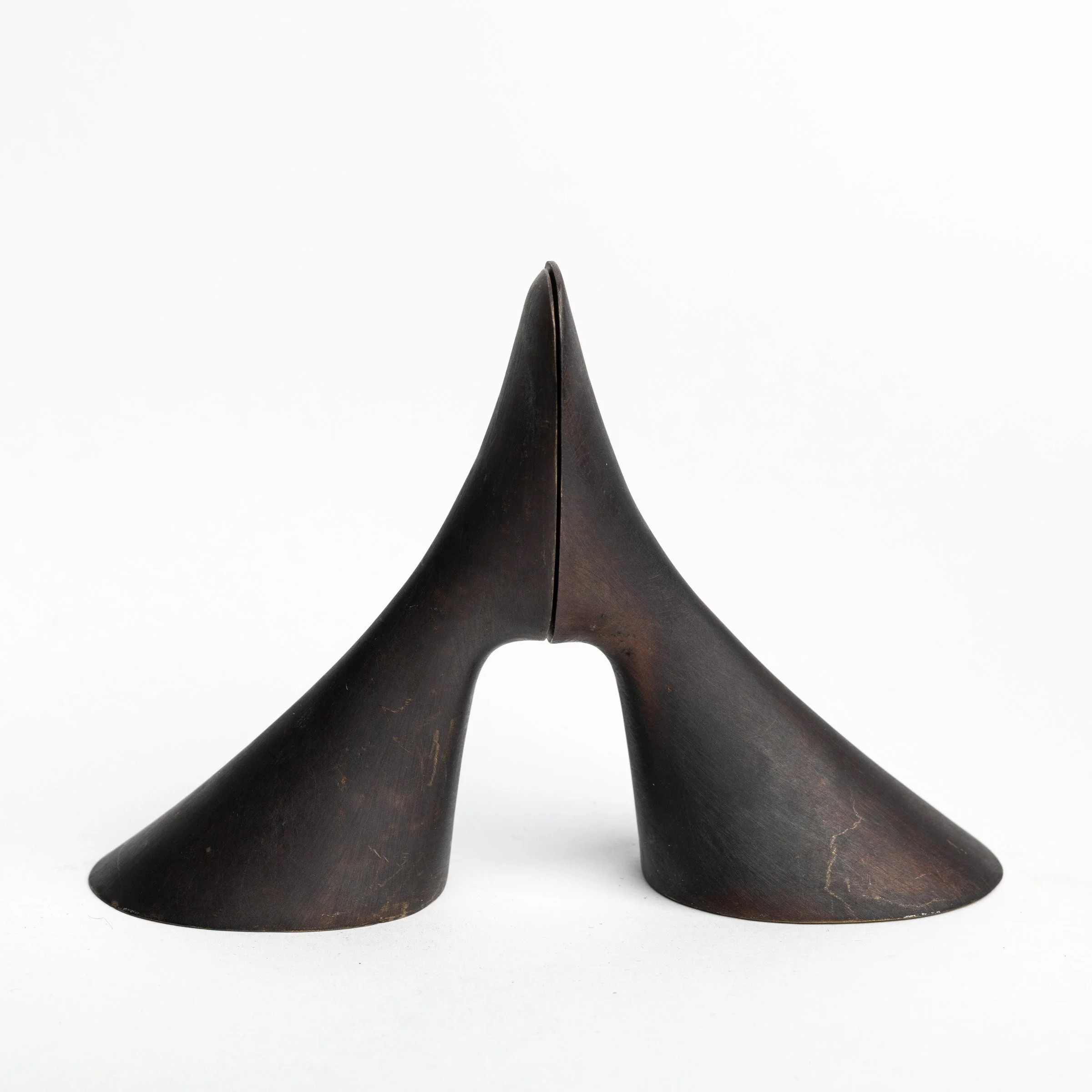
Designer: Carl Auböck II (1900 – 1957)
Item: Praying Hands Bookends Version II Model #3651
Manufactured by: Werkstätte Carl Auböck
Country of origin: Austria
Year made: Designed 1947, this pair made likely early 1980s
Materials: Patinated Brass
Dimensions: Each is 4 ¾” x 2 ¼” x 3 ½”
Condition: Very Good to Excellent.
Description: Here is another iconic Auböck design for bookends commonly referred to as Praying Hands Version II and is model #3651, dating the actual original design to 1947. This pair were likely manufactured in the earlier 1980s based on the patination and age to the nonpatinated base sections, as well as the retail price sticker on the bottom of one example. This is a well documented model and is still being produced, but the contemporary versions have a very highly polished finish to both the bottom bases and the top flats where they meet. As shown, the bottom bases were not patinated, and not polished, and the hands that meet are patinated. Both are marked with a proper vintage Auböck and Made in Austria impressed marks, as well as the numbers 02 as shown. We are unsure if this numbering means they were factory seconds or not, because on other pairs of bookends we have seen the number 1 and then 2 indicating a matching pair. There is also a paper label affixed likely from the retailer with a retail price of $435, likely dating this piece to the 1980s. The paper label appears to have at least 40 years of aging to it.
References: Kois, Clemens, Carl Auböck: The Workshop, Powerhouse Books (2012); Auböck, Carl IV, die kataloge der werkstätte carl auböck 1925 - 1975, Carl Auböck Archive (2005); Auböck, Carl IV, die arbeiten der Werkstätte carl auböck – fotografiert von 1948 – 2005, Carl Auböck Archive (2009).
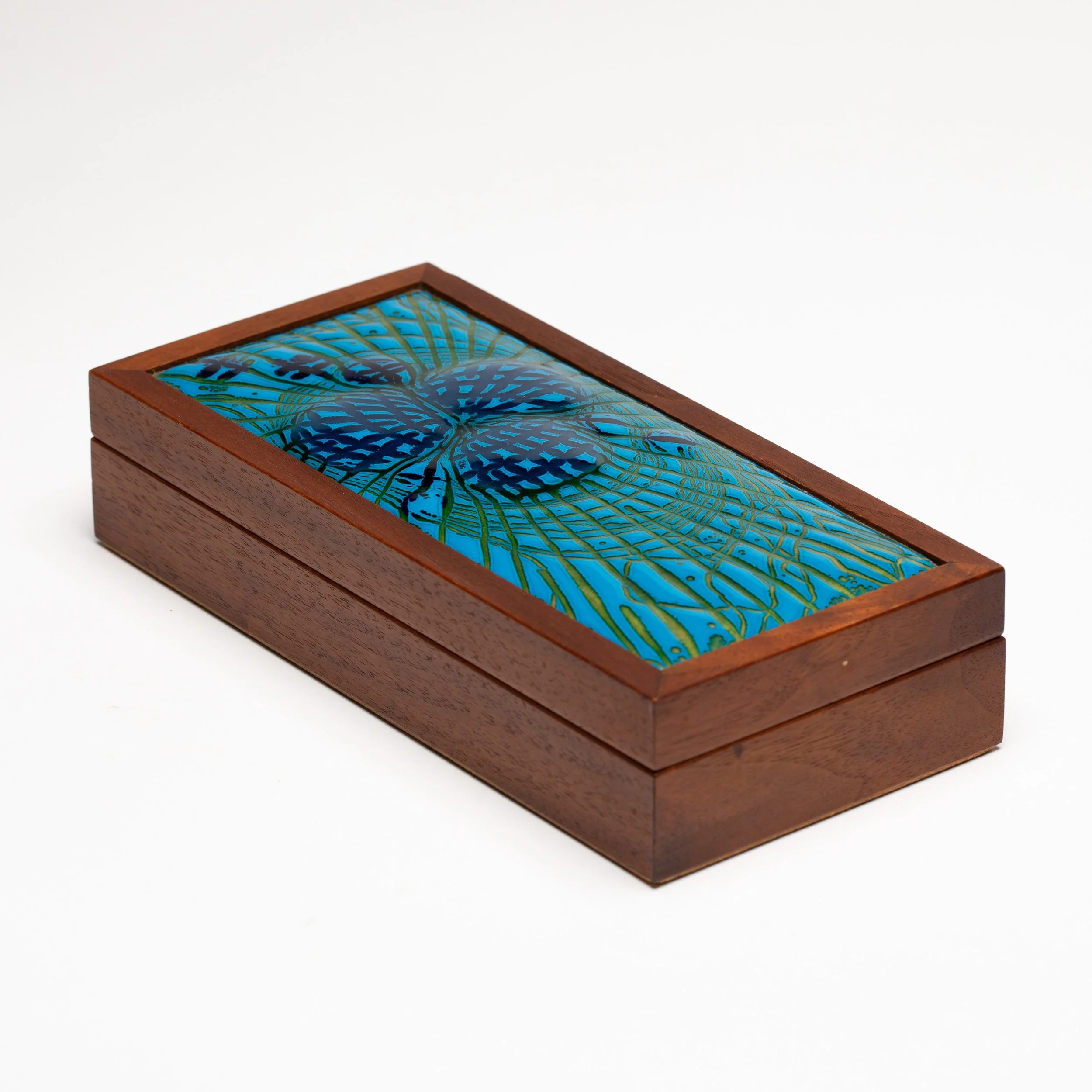
Designer: Annemarie Davidson (1920 – 2012)
Item: Enamel Lidded Jewels Box
Manufactured by: Annemarie Davidson and Blaine Rath
Country of origin: United States
Year made: Circa 1960
Materials: Copper enamel tile on Walnut wood box
Dimensions: 1 ½” x 9 ¼” x 3 ½”
Condition: Excellent
Description: Here is a beautiful lidded long box by Davidson in walnut with an enameled copper plaque inlaid into the top. The decoration in the enamel work is Davidson’s most highly regarded and collected Jewels design where she used glass and thick enamel to achieve a rich irradiance, glow and three-dimensional surface on the enamel. These abstracted Jewels designs are considered Davidson’s most highly acclaimed and accomplished art works. This box appears to be for holding two decks of playing cards, but can also be used for jewelry or other trinkets. Davidson’s boxes have cork bottoms with her cypher usually in ink, but it appears on this example the cypher has rubbed off the cork. created all her enamel work alone from start to finish.
Davidson’s desk accessories (e.g. lidded boxes, pen holders, blotters, bookends, and lighters) were a collaboration with the noted woodworking artist Blaine Rath starting in 1959 and are much harder to find, because not many were produced. Although Davidson’s enamel plates and dishes with objective imagery are ubiquitous, inexpensive, and abundant, her abstracted desk accessories (i.e. bookends, boxes, pen holders, blotters, etc.) are fairly hard to find. Davidson collaborated with Rath who was an established woodworker and well regarded studio artist in her own right, to produce the boxes and other wood bases for Davidson’s enamel art. However, very little biographical information about Rath is available.
Davidson was born in Berlin in 1920, and came to the US in 1936. She studied economics at New York University and later at Columbia University. She studied enameling with the prominent enamel pioneer Doris Hall in the 1950s. Davidson moved to southern California with her husband in 1946, and lived and worked in the Los Angeles area until her death in 2012. Her early abstract work is her most highly regarded, and was exhibited at California Design in 1960. She was listed in Craftsmen of the Southwest in 1965 which only listed 8 enamelists total including Fred Ball, Margaret Montgomery Barlow, Nik Krevitsky, June Schwarcz, Kay Whitcomb and Elllamarie and Jackson Woolley. In her work, Davidson frequently uses pieces of glass of varying sizes to create irregular organic shapes which she calls “jewels.” These raised forms appear to float on the liquid surface of the vessel or plaque. For many of her abstract compositions, she also uses a sgraffito technique, incising straight lines with the sharp point of a dart. These hand-drawn lines, which fan out from a central focal point, present a linear counterpoint to the more fluid, organic and sculptural form of the jewels.
Her works were exhibited in her lifetime at the Pasadena Art Museum, Long Beach Museum of Art, Mobile Museum of Art and the Cleveland Museum of Art. Her work can also be found other important museum collections, and a similar example of this box is in the Philadelphia Museum of Art permanent collection.
References: Nelson, Harold; Jazzar, Bernard, Painting with Fire: Masters of Enameling in America, 1930-1980. Long Beach Museum of Art, California (2006); Rosenberg, Alan, Alluring Enamel. Modernism Magazine: (Spring 2003) pages 68–72; Jazzar, Bernard N and Nelson, Harold B. The Enamels of Annemarie Davidson, Glass on Metal, The Enamelist’s Magazine, Volume 27 Number 5 December 2008, pages 98-100; periodical California Design: 6 in 1960.
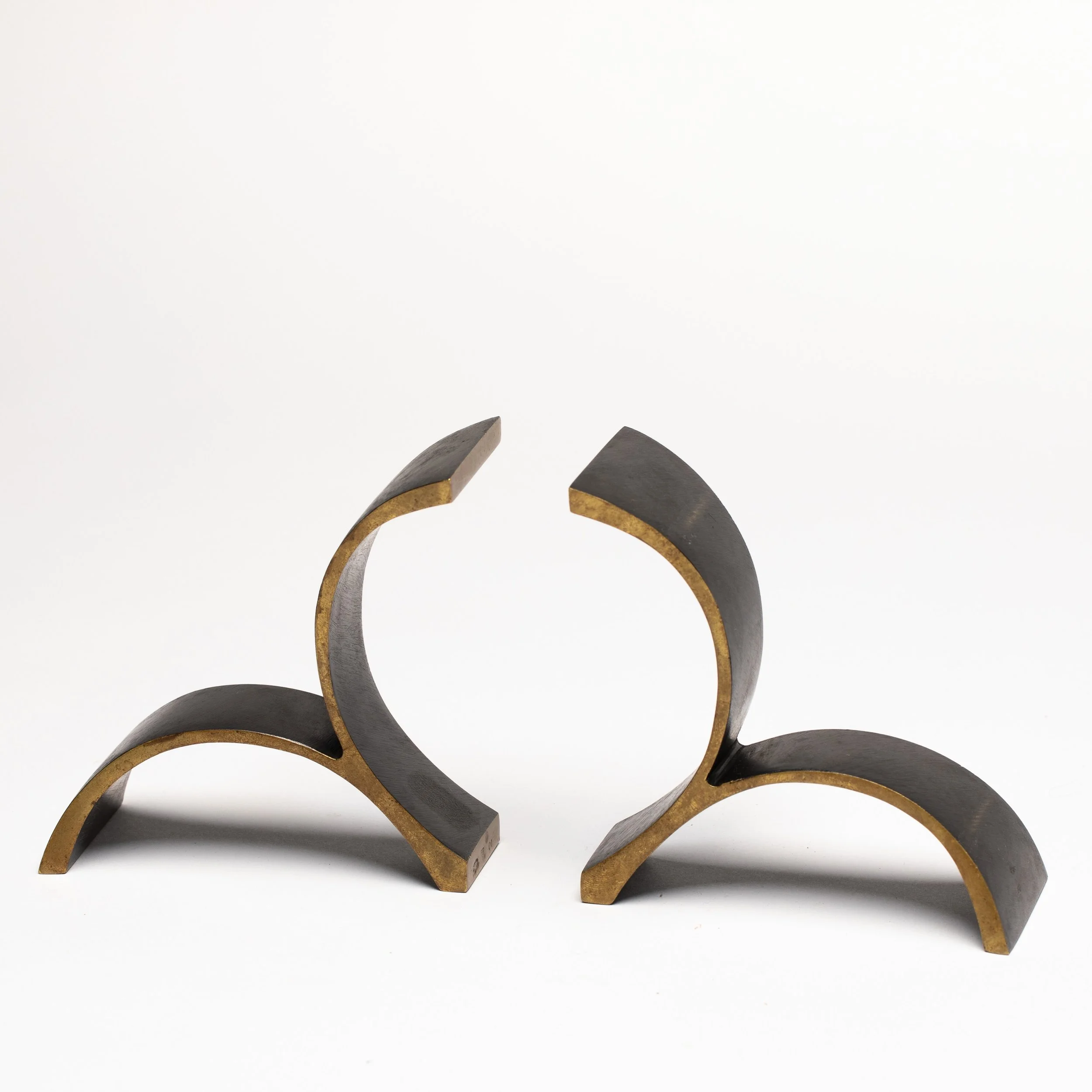
Designer: Richard Rohac (1906 – 1956)
Item: Wings Bookends
Manufactured by: Richard Rohac
Country of origin: Austria
Year made: Late 1940s
Materials: Patinated and unpolished brass
Dimensions: Each are 4 ½” x 4 ½” x 2”
Condition: Very good. We have left these unpolished and as found estate condition, so there are some places where the patination is rubbed, as seen in the photos.
Description: Another fine, well executed and elegant pair of patinated brass bookends by Richard Rohac. This set is fully signed with the Rohac reverse Rs cypher and his unique Made in Austria marks, and also retains the impressed numbers 1 and 2, as shown.
This set was easy to date because the unpatinated edges show unevenness and blotchy brass indicative of brass works from Austria immediately after World War II when brass shell casings from munitions were melted for use. The brass was very impure with imperfections creating this splotchy or quilted look to the unpatinated finish. This use of a very dark patination to obscure the impure brass was also used by the major Vienna workshops.
Rohac was a master metal craftsman who began and completed his apprenticeship with the Werkstatte Hagenauer in Vienna, Austria as a teenager and stayed with the workshop another nine years before opening his own metalwork business in 1932. Often Rohac’s bookends, ashtrays and candlesticks compete well with the overall quality, craftsmanship and designs of the Vienna workshops of Hagenauer (where he apprenticed) and Carl Auböck, but at a much more reasonable price point.
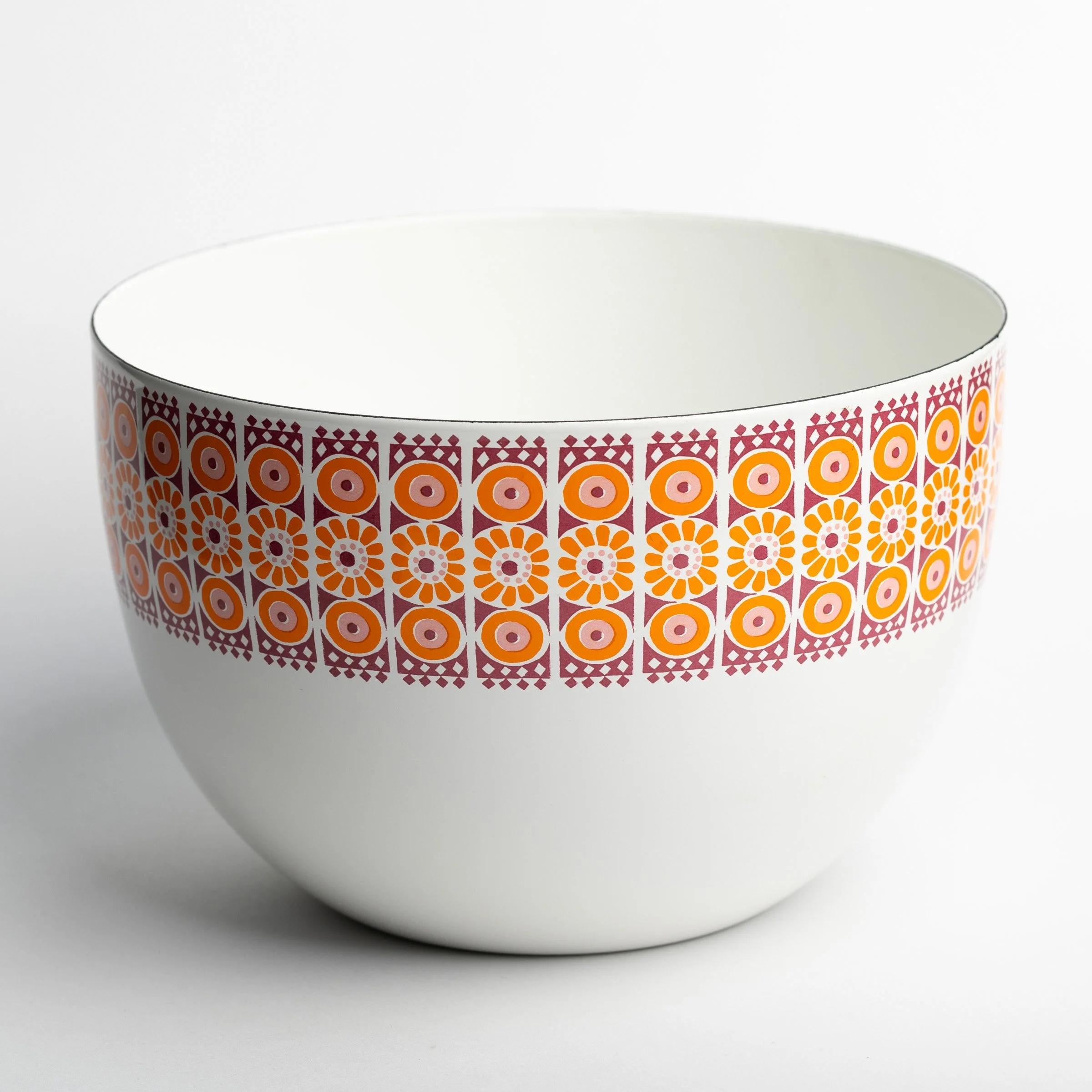
Designer: Kaj Franck (1911 – 1989), pattern designer Raija Uosikkinen (1923 - 2004)
Item: Kerha Bowl
Manufactured by: Finel (Arabia)
Country of origin: Finland
Year made: 1950s
Materials: Steel with enamel finish
Dimensions: 5 ½” x 8 ¼” in diameter
Condition: Excellent, near mint
Description: Here is a very hard-to-find Kehra bowl by Raija Uosikkinen the purple and orange decoration on a white ground. The Kerha bowl is usually found with a red ground and black decoration. Raija Uosikkinen was one of the leading Finnish decorators of the 20th century, and spent her entire four decade career working at the Arbaia factory, but mostly worked on ceramics. We have seen and handled a few of this model, but almost always with obvious and noticeable condition issues. This example is as close to mint as you are likely to find. Therefore we have priced this accordingly.
Kaj Franck was one of Finland’s leading and influential figures of design and applied arts between 1940 and 1980. He is probably best known for his ceramic designs for Arabia of Finland (now known as Ittala) that became the parent company of Finel who produced this bowl and as well as other steel and enameled kitchen wares. Franck went to work for Arabia in 1945 and then became the artistic director of its ceramic factory three years later. He also designed glass and steel objects.
The design of this physical bowl shape is by Franck, but the outer decorations were outsourced to other major Finnish illustrators and ceramic pattern designers such as Esteri Tomula, Raija Uosikkinen, and Heikki Orvola. Franck’s designs are in most major museum collections, and the Museum of Modern Art in New York City held his first retrospective in 1992. Many of his ceramic and glass designs are still in production and sold through Ittala.
Finel was a brand under which Wärtsilä and Järvenpää Emali created enamel kitchenware and tableware items from as early as the 1950s. In the early 1960s Wärtsilä rebranded their enamel ware division as Finel. In the early 1980s the brand was sold to Hackman Finland, and some examples of these bowls bear that foil label. It is estimated that over 500,000 of these steel bowls were produced over the decades. However, the vast majority were popular designs such as mushrooms, vegetables and other commonly found themes, and since these were used for everyday kitchen and serving purposes, almost all the examples available have condition issues, such as chipping and losses on the top edges, utensil scratching and other problems. Finding the rarer examples in excellent condition is a real challenge.
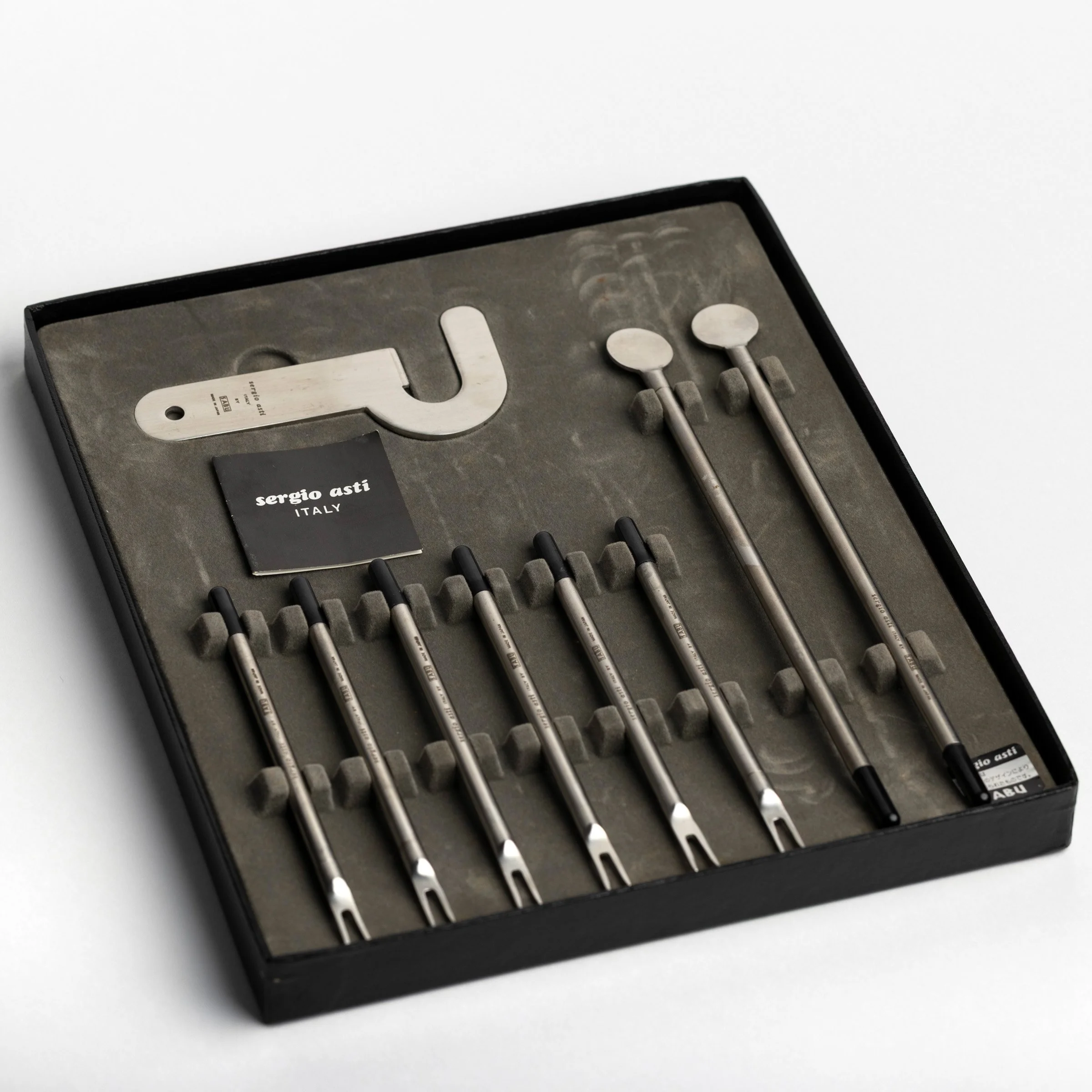
Designer: Sergio Asti (1926 – 2021)
Item: SABU Bar Tools Set
Manufactured by: SABU
Country of origin: Japan
Year made: 1970s
Materials: Brushed Stainless Steel and rubber
Dimensions: External dimensions of the box are 1” x 9 ¾” x 8 ¼”
Condition: Mint in original box with paper insert
Description: Here is a very rarely found set of bar tools by Sergio Asti designed for the Japanese firm SABU. Each piece is marked “Sergio Asti Italy by SABU Made in Japan” as shown in the photos. The set consists of six olive or fruit forks, two muddlers or stirring rods and one bottle opener. We have seen the bottle opener sold separately and have only seen one other complete set.
Sergio Asti was an Italian architect and designer born in Milan, Italy. After graduating from the Milan Polytechnic, he began his career in the mid-50s he was an assistant professor of interior architecture from 1953 to 1958. Asti was considered one of the leading designers of his generation, and he collaborated with some of the most important companies of the time (and today) such as Cassina, Knoll, Poltronova, Zanotta, Gabbianelli, Salviati, Heller, Venini, Arteluce, Artemide, Fontana Arte, and Martinelli.
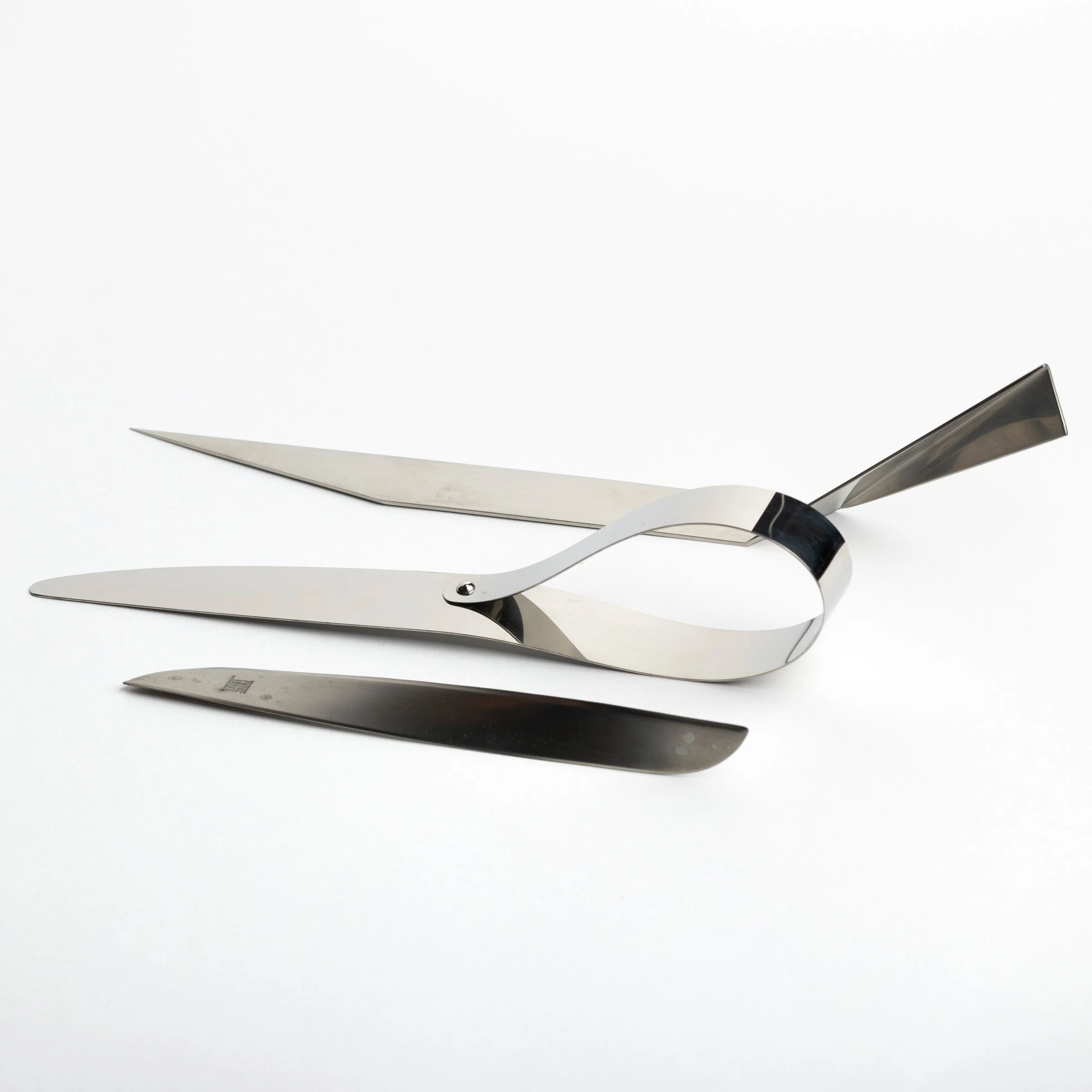
Designer: Enzo Mari (b. 1932)
Item: Letter Openers
Manufactured by: Danese Milano
Country of origin: Italy
Year made: 1961, 1962 and 1985
Materials: Stainless steel
Dimensions: Ameland is 8 ½” long x ¾”, Bencecula is 13 ½” long x 1” x 2 ½” and Giglio is 11” long x 2 ½” x 1”, and the original packing boxes are 1” x ¾” x 8 ½”, 1 ¼” x 4 ½” x 14 ¾” and 1 ¼” x 2 ½” x 11” respectively.
Condition: All are mint in original boxes, New Old Stock
Description: Here are three vintage Enzo Mari letter openers being sold as a set. The Ameland is the most famous and ubiquitous design for a letter opener by Enzo Mari made for retail sale at the Museum of Modern Art’s (MOMA) book and gift store in 1962, and still being made today. The Benbecula designed in 1961 is perhaps the hardest of these openers to find. The Giglio has a round handle and was designed in 1985, and this example retains its paper insert and original MOMA label. All are marked with the Danese Milano marks and dated, as shown. Although Danese still manufactures these designs, these examples are vintage pieces, likely from the late 1980s.
Examples of these designs can be found in the permanent collections of the Museum of Modern Art, Philadelphia Museum of Art, the Brooklyn Museum and other major museum design collections.
References: Danese Milano, manufacturer's catalog, 1976, pg. 96 Enzo Mari: L'arte del Design, Galleria Civica d'Arte Moderna e Contemporanea di Torino exhibition catalog, pg. 176.
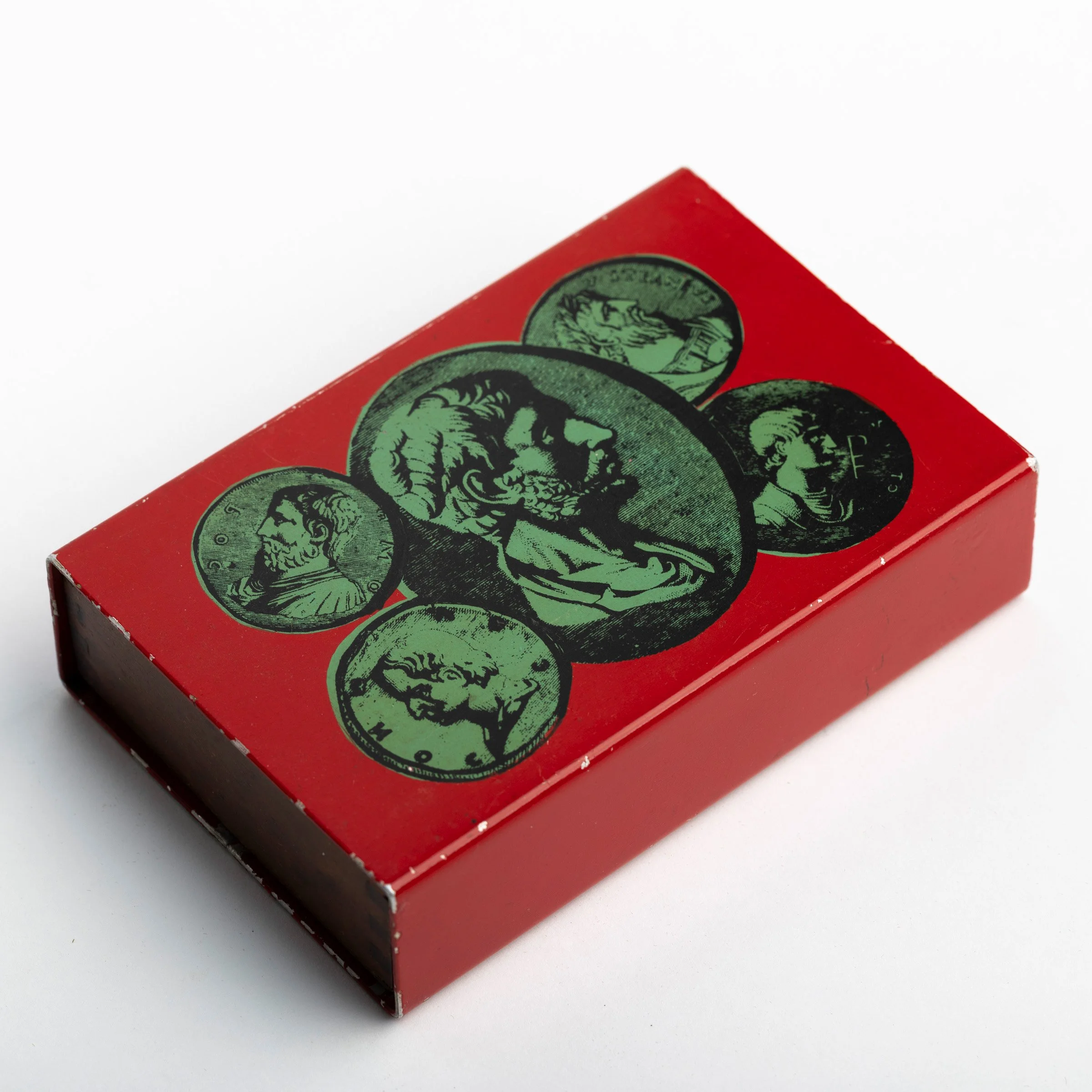
Designer: Piero Fornasetti (1913 – 1988)
Item: Monete Romane (Roman Coins) Box
Manufactured by: Piero Fornasetti
Country of origin: Italy
Year made: 1950s
Materials: Steel with mahogany wood slide, silkscreen printed images, paint.
Dimensions: Box is 1 ½” x 5 ½” x 3 ½”
Condition: Very good with a few scattered minor losses of paint as shown.
Description: Here is another rare example of Fornasetti’s well known Roman Coins box with its original green felt but the Fornasetti logo is rubbed beyond recognition.
References: Fornasetti, Barnaba, Fornasetti: The Complete Universe, Rizzoli (2010), page 500.
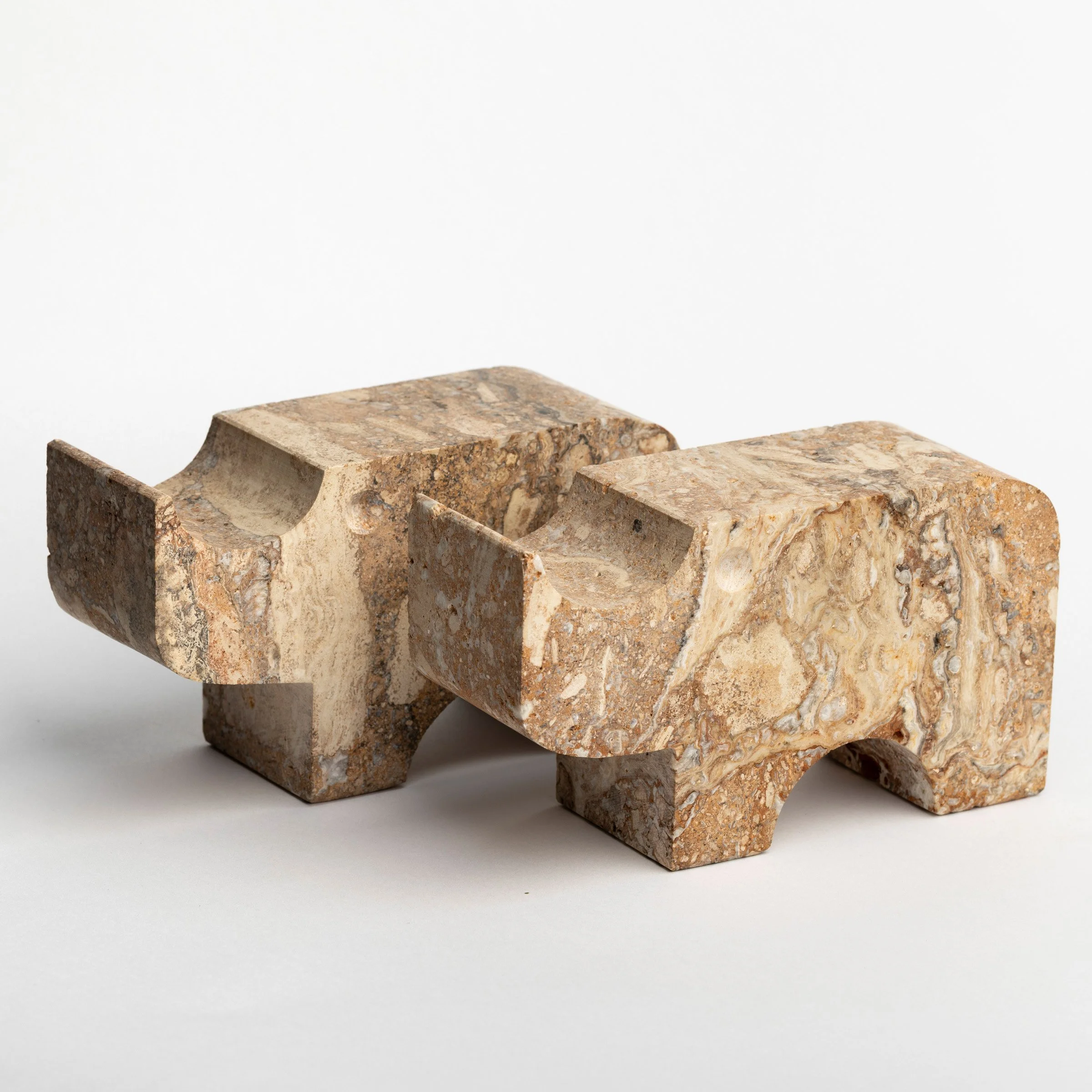
Designer: Flli Mannelli (Mannelli Brothers)
Item: Mannelli Travertine Rhinoceros Bookends
Manufactured by: Fratelli Mannelli for Vero Travertino di Rapolano
Country of origin: Italy
Year made: Circa 1970
Materials: Pink Travertine Marble
Dimensions: Each is 4” x 7” x 2 ½”
Condition: Very good. Some natural roughness that can seen on some edges as to be expected with Travertine.
Description: Here is an important pair of larger Fratelli Mannelli travertine bookends in the shape of a Rhinoceros. The more commonly found animals are elephants and giraffes. The travertine used for these examples is a rarely found light pinkish shade. Each weigh nearly 5 pounds and each has the Flli Mannelli design labels, as well as the Vero Travertino do Rapolano labels affixed to the bottoms, as shown.
Designer: Annemarie Davidson (1920 – 2012)
Item: Enamel Jewel Bookends
Manufactured by: Annemarie Davidson and Blaine Rath
Country of origin: United States
Year made: Circa 1960s
Materials: Copper, enamel, glass inset into Mahogany wood blocks, cork bottoms
Dimensions: Each are 7” x 4 ½” x 2 ¾”
Condition: Excellent. The enamel plaques are flawless. The cork bottoms have some small bulges where the cork expanded likely by exposure to some moisture.
Description: Here is a beautiful pair of very heavy bookends by Annemarie Davidson in thick Mahogany blocks fabricated by the artist Blaine Rath with heavy enameled copper plaques by Davidson inlaid into the wood. The decoration on the enamel work is Davidson’s most highly regarded and collected Jewels design where she used glass and thick enamel to achieve a rich irradiance, glow and three-dimensional surface on the enamel. This design is similar to a couple others we have seen with psychedelic orbs and ray bursts. These abstracted Jewels designs are considered her most highly acclaimed and accomplished art works. Davidson created all her enamel works alone from start to finish. Each bookend is signed on the bottom with her cypher initials as shown. Each weighs about 4 pounds so they do hold up books. The bookends are rare and we have only seen a handful of other pairs.
Davidson appears to have earned a living making decorative enamel plates and dishes with designs of animals, birds, flowers, clowns, landscapes, Native American motifs, and other objective imagery drawn from the real world. We have even seen them with pictures of golf courses. These were made for the commercial market in great numbers and are ubiquitous, inexpensive, and are easily found in secondhand and thrift stores. However, the Jewels works were her “fine art” and demonstrate a true artistic talent that is becoming quite sought after. The Jewels works are also a great accompaniment to midcentury modern designed furniture and interiors. Davidson’s desk accessories (i.e. lidded boxes, pen holders, blotters, bookends, etc.) were a collaboration with the noted woodworking artist Blaine Rath starting in 1959 and are much harder to find, because not many were produced.
Davidson was born in Berlin in 1920 and came to the US in 1936. She studied at New York University and later at Columbia University. Davidson moved to southern California with her husband in 1946, and lived and worked in the Los Angeles area until her death in 2012. She studied enameling with the prominent enamel pioneer Doris Hall in the 1950s. Her early abstract work is her most highly regarded, and was exhibited at California Design in 1960 and the Pasadena Art Museum in 1961, 1962 and 1965. She was listed in Craftsmen of the Southwest in 1965 which only listed eight enamelists in total including Fred Ball, Margaret Montgomery Barlow, Nik Krevitsky, June Schwarcz, Kay Whitcomb, and Elllamarie and Jackson Woolley. Davidson frequently used pieces of glass of varying sizes to create irregular organic shapes which she called “jewels.” These raised forms appear to float on the liquid surface of the vessel or plaque. On many of her abstract compositions she also used a sgraffito technique, incising straight lines with the sharp point of a dart. These hand-drawn lines, which fan out from a central focal point, present a linear counterpoint to the more fluid, organic and sculptural form of the jewels.
Davidson’s works were exhibited and purchased in during her lifetime by the Pasadena Art Museum, Long Beach Museum of Art, Mobile Museum of Art and the Cleveland Museum of Art.
References: Nelson, Harold; Jazzar, Bernard, Painting with Fire: Masters of Enameling in America, 1930-1980. Long Beach Museum of Art, California (2006); Rosenberg, Alan, Alluring Enamel. Modernism Magazine: (Spring 2003) pgs 68–72; Jazzar, Bernard N and Nelson, Harold B. The Enamels of Annemarie Davidson, Glass on Metal, The Enamellist’s Magazine, Volume 27 Number 5 December 2008, pgs 98-100; periodical California Design: 6 in 1960.